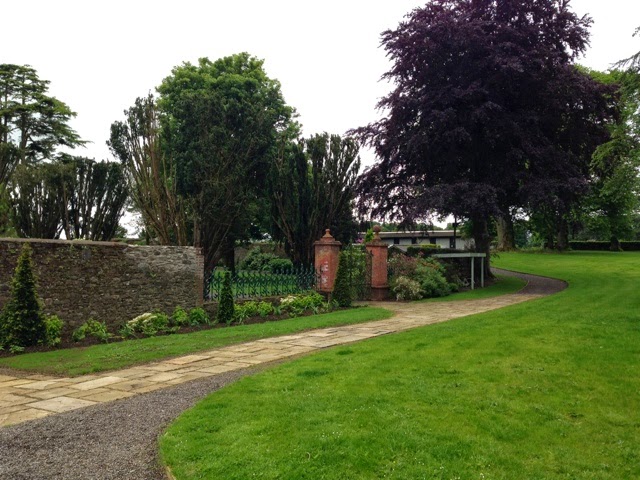
This is the estate house where we spent the night. The place is called Tankardstown. It was just lovely and quiet and a great place where one can get away from it all! I could not find much information on the history of the home and the grounds, but it was lovely all the same. It was richly decorated and we received a warm welcome upon our arrival. There are a few rooms in the main house and there are a few cottages as well. The restaurant is fabulous and we had a fantastic meal and then relaxed in the gorgeous rooms on the main floor.
This is in the hallway for morning breakfast and afternoon tea.
And in our room was the chilled Champagne that was our anniversary gift from us to us!
And here on the grounds was the first squirrel we saw in Ireland! (Not counting Haley of course...)
Monday, 16 June 2014
Slane Abbey
Ireland abounds with abbeys and monasteries! Everywhere we go, there are abbey and monastery ruins to see, yet I never tire of seeing them. They are like rainbows!
The story is that St. Patrick lit an Easter fire on the Hill of Slane, before the Druids could light the fire for their feast day on the Hill of Tara. Seeing the light of the fire on the Hill of Slane, they warned the High King that if St. Patrick's fire was not put out immediately, it would burn forever in Ireland. The rest is, of course, Irish history...
I think we look pretty good for having toured for many hours already!
This kind of tree intrigues me. It looks like a pine tree, but the trunk is kind of like a palm tree, and the branches aren't just regular pine needles. The photo doesn't do it justice, but I have seen a few of these around and so far have been unable to identify them.
Statue of the Man of the Hill aka St. Patrick.
The story is that St. Patrick lit an Easter fire on the Hill of Slane, before the Druids could light the fire for their feast day on the Hill of Tara. Seeing the light of the fire on the Hill of Slane, they warned the High King that if St. Patrick's fire was not put out immediately, it would burn forever in Ireland. The rest is, of course, Irish history...
I think we look pretty good for having toured for many hours already!
This kind of tree intrigues me. It looks like a pine tree, but the trunk is kind of like a palm tree, and the branches aren't just regular pine needles. The photo doesn't do it justice, but I have seen a few of these around and so far have been unable to identify them.
Statue of the Man of the Hill aka St. Patrick.
Sunday, 15 June 2014
Kells
After all the hiking around Loughcrew, it was time to find a village with a pub. Fortunately, in Ireland, that's easy to do! We hopped in the car, successfully maneuvered down the road without having to reverse, and headed to Kells for lunch and more touring.
There were at least 5 High Crosses in Kells. The oldest one stands beside the Round Tower and is inscribed with words meaning "The Cross of Patrick and Columba" It is believed this cross was erected shortly after the founding of the monastery.
The Round Tower was built in the 10th century. It is 90 feet high and has 6 floors. It has no internal staircase. It required a ladder to get onto the floors, and each floor has one window. The raised doorway made the tower stronger and more difficult to attack. These towers are called "Cloigteach" or bell towers. They were used for lookouts and for protection from Viking attacks. There are five windows at the top that allowed them to view all the five ancient roads leading into the town of Kells.
There are two other high crosses in the graveyard. Below is a photo of one taken at some time between 1888 and 1914.
We parked in the town and found a nice pub connected to the Headfort Arms Hotel, called the Kelltic Pub. It was full of character! We sat at the bar, had a nice lunch and tried a new stout from the Bru Brewery of Trim. The stout was called Bru Dubh and it was delicious! Now we are planning to schedule a tour of the brewery, which was just opened in 2013.
Steve in front of the St. Vincent de Paul offices in Kells.
Kells is famous as the monastic village which housed the Book of Kells, though it was not actually written in Kells. In 807 AD the Columban monks left Iona in western Scotland because of Viking attacks and moved their monastic headquarters to Kells. The illustrated copy of the gospels was made about the time they came to Ireland.
This plaque is on the Churchyard wall and the wall marks the boundary of the original monastery that was rebuilt in 1714. The picture below represents the monastery grounds around 1000 AD.
The original Church no longer stands. The west porch of the great stone Church housed the sacred vessels and the Book of Kells. The Book was stolen in 1007 AD, and was found 2 months later without it's lavish cover. Below is the symbol of St. John in the Book of Kells.
There were at least 5 High Crosses in Kells. The oldest one stands beside the Round Tower and is inscribed with words meaning "The Cross of Patrick and Columba" It is believed this cross was erected shortly after the founding of the monastery.
The Round Tower was built in the 10th century. It is 90 feet high and has 6 floors. It has no internal staircase. It required a ladder to get onto the floors, and each floor has one window. The raised doorway made the tower stronger and more difficult to attack. These towers are called "Cloigteach" or bell towers. They were used for lookouts and for protection from Viking attacks. There are five windows at the top that allowed them to view all the five ancient roads leading into the town of Kells.
There are two other high crosses in the graveyard. Below is a photo of one taken at some time between 1888 and 1914.
Subscribe to:
Posts (Atom)