
Sunday, 26 October 2014
Dunbrody Abbey
So we had a lovely Bank Holiday weekend and dined very well at Dunbrody House. We headed for home on Monday and saw the Abbey on our way out of town. There is a lot to see in County Wexford, including the ancestral home of the Kennedy's and the Dunbrody Famine Ship. Once again, we will need to come back...

Slade Castle
As we drove back to Dunbrody House, we saw this ruin and so stopped to have a look. It is funny houw many ruins there are here and sometimes they are just kind of THERE. This one has a sign telling about it but as far as the castle itself, it is used to store crab pots!


Saturday, 25 October 2014
Hawks at Hook!
We saw this car in the parking lot at the Hook Lighthouse! It was so windy and chilly, we couldn't just stand out there waiting for them to show up. When we were heading out, the car was gone.

Hook Lighthouse
The Hook Lighthouse is the oldest intact operational lighthouse in the world! It is a 13th Century building that still stands and still operates to this day!
It is made of limestone and has 4 stories. It stands 36 meters high and the stairway has 115 steps.




Inside they used the crossing beams and the inside part is the Keystone. The lighthouse was built by William Marshall, a son-in-law to Strongbow and Aoife. He was responsible for the building of many other castles and buildings in Ireland. The lighthouse originally used a fire to serve as the beacon to ships at sea. It was kept lit by monks who lived in the lighthouse and worked to keep the fire burning in the top, by carrying the coal up the steps to the top. Now it is lit by electricity.


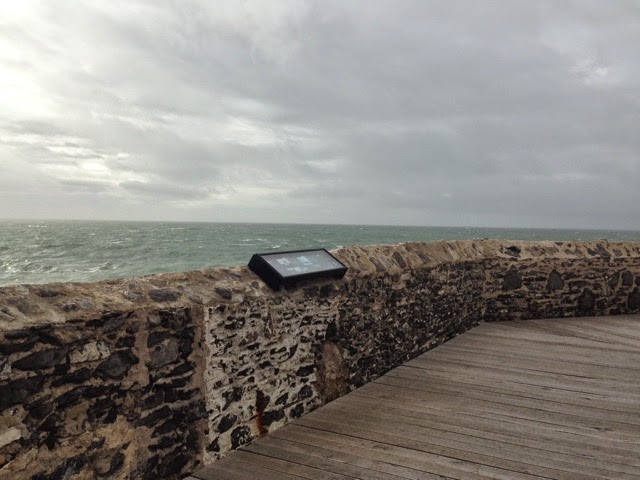
Views from the top of the lighthouse. It was a very windy day so it was a little scary! Steve did not venture too far out from the doorway at the top.


It is made of limestone and has 4 stories. It stands 36 meters high and the stairway has 115 steps.
Inside they used the crossing beams and the inside part is the Keystone. The lighthouse was built by William Marshall, a son-in-law to Strongbow and Aoife. He was responsible for the building of many other castles and buildings in Ireland. The lighthouse originally used a fire to serve as the beacon to ships at sea. It was kept lit by monks who lived in the lighthouse and worked to keep the fire burning in the top, by carrying the coal up the steps to the top. Now it is lit by electricity.
Views from the top of the lighthouse. It was a very windy day so it was a little scary! Steve did not venture too far out from the doorway at the top.
Loftus Hall
This is the most haunted house in Ireland! I had read about it last year and wanted to see it but then forgot about it. Then, as we were driving to the Hook Lighthouse, there it was! So we drove down the lane. It wasn't open until later in the day, and we weren't going to wait around. I have since seen some of the stuff about it and it seems to me to be a rather cheesy haunted house tour, so I don't have plans to go see it. I do not go on haunted house tours where they just try to scare me - I am quite easily freaked out anyway!
The story goes that the family living there had a knock on the door and let in a man who said he had come by sea and gotten lost. They took him in and made him welcome and the adult daughter was entranced by him. While they were playing cards, she dropped a card and when she bent down to pick it up, she saw his feet under the table. Instead of feet, he had cloven hooves. He turned into a spirit and flew out of the house making a hole in the roof. The daughter went insane and was kept in an upstairs room for the rest of her life and the family firmly believed they had been visited by Satan.
So even though we didn't go inside, it was an appropriate stop for the weekend before Halloween!


The story goes that the family living there had a knock on the door and let in a man who said he had come by sea and gotten lost. They took him in and made him welcome and the adult daughter was entranced by him. While they were playing cards, she dropped a card and when she bent down to pick it up, she saw his feet under the table. Instead of feet, he had cloven hooves. He turned into a spirit and flew out of the house making a hole in the roof. The daughter went insane and was kept in an upstairs room for the rest of her life and the family firmly believed they had been visited by Satan.
So even though we didn't go inside, it was an appropriate stop for the weekend before Halloween!
Templetown
After having a lovely evening at the pub on site at the manor house, we awoke and had a splendid Irish breakfast and then popped into the car to head out to the Hook Peninsula. We saw lots of things along the way!
This was a church and graveyard that we saw as we drove to the Hook Lighthouse. We were intrigued because it was close to the road and the sea and it was fairly well intact.
The sign posted at the ruin said it was Templetown and gave the following information: "The Knights Templars were founded by the Crusaders in Jerusalem, early in the twelfth century. In 1172, King Henry II granted extensive lands to the Templars along the eastern shore of Waterford Harbour. They set up their headquarters here at Templetown, which is named after them, and at nearby Kilcloggan. The Templars were disbanded in 1307 and their lands were given to their great rivals, the Knights Hospitallers who built the fortified church at Templetown and the castle at Kilcloggan."
In 1307 the Knights Templar were essentially arrested and imprisoned and charged with various things, though most likely they were trumped up charges designed to disband them and divide up their wealth and prevent them from becoming too powerful.


It looked like you could go inside the tower and possibly climb the steps, but it was dark and scary and too close to Halloween for that! Also, it was probably not safe.

I love how they keep the ruins but also make use of the land for cows and sheep. Almost every ruin is in a pasture!


This was a church and graveyard that we saw as we drove to the Hook Lighthouse. We were intrigued because it was close to the road and the sea and it was fairly well intact.
The sign posted at the ruin said it was Templetown and gave the following information: "The Knights Templars were founded by the Crusaders in Jerusalem, early in the twelfth century. In 1172, King Henry II granted extensive lands to the Templars along the eastern shore of Waterford Harbour. They set up their headquarters here at Templetown, which is named after them, and at nearby Kilcloggan. The Templars were disbanded in 1307 and their lands were given to their great rivals, the Knights Hospitallers who built the fortified church at Templetown and the castle at Kilcloggan."
In 1307 the Knights Templar were essentially arrested and imprisoned and charged with various things, though most likely they were trumped up charges designed to disband them and divide up their wealth and prevent them from becoming too powerful.
It looked like you could go inside the tower and possibly climb the steps, but it was dark and scary and too close to Halloween for that! Also, it was probably not safe.
I love how they keep the ruins but also make use of the land for cows and sheep. Almost every ruin is in a pasture!
Dunbrody House
After seeing lots of Waterford, we took a ferry across the River Suir and headed to our hotel in County Wexford. We stayed at the Dunbrody House, which was a manor house turned into a hotel and our first joy was a gift from us to us: Cheers!


Subscribe to:
Posts (Atom)